
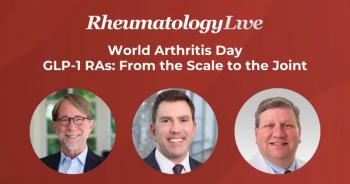
On World Arthritis Day, TOGETHER-PsA data and 3 rheumatology/derm experts frame GLP-1 agonists as a promising — but not yet proven — adjunct therapy.
On World Arthritis Day, TOGETHER-PsA data and 3 rheumatology/derm experts frame GLP-1 agonists as a promising — but not yet proven — adjunct therapy.

At Week 52, ixekizumab plus tirzepatide sustained gains in skin clearance, joint response and metabolic measures versus ixekizumab alone.

Werth discusses what the 52-week AMETHYST Part A data add to the case for litifilimab in antimalarial-refractory cutaneous lupus erythematosus.

Amplio Pharma now planning a phase 2a study after NovoBioJect raised intracellular active methotrexate levels by 38%.
The EC approved upadacitinib for active polyarticular JIA in children 2 years and older, based on phase 1 SELECT-YOUTH efficacy and safety data.

Amgen reported dazodalibep met its primary endpoint in the phase 3 OASIZ-301 trial, improving ESSDAI score in moderate-to-severe systemic Sjögren's disease.

Rozanolixizumab improved FIQR score at 10 weeks but did not reach 2-sided statistical significance on its primary BPI-SF interference endpoint.

Two-year data from the open-label extension show sustained ACR and MDA response rates for the TYK2 inhibitor in active psoriatic arthritis.

Oberlin outlines what dermatologists should weigh, beyond APEX's radiographic data, when selecting a biologic for PsA.

Beeline Medicines reported positive topline data meeting primary SRI-4 endpoint at week 48 across all 3 doses in systemic lupus erythematosus.

The designation follows phase 2 IMPACT trial data showing reduced adverse pregnancy outcomes in high-risk antiphospholipid syndrome.

In a large real-world PsA cohort, higher BMI reduced the odds of minimal disease activity, especially with TNF inhibitors other than infliximab.

August 2026 rheumatology highlights include FDA approval of brepocitinib for dermatomyositis and garetosmab-grts for FOP, and new trial data.

Population data from Greater Manchester show Black, Asian, and mixed-ethnicity patients with lupus receive greater oral corticosteroid doses.
The approval adds brepocitinib (Lisraya), an oral JAK/TYK2 inhibitor, as the first agent specifically studied and approved for dermatomyositis in adults.

Baseline structural damage accounted for most of the variance in placebo-arm radiographic progression across 6 PsA trials.
Garetosmab-grts is the first treatment demonstrating reduced new heterotopic ossification lesions and flare-ups in adults with FOP.

Efgartigimod produced significant, sustained improvement in autoimmune myositis, including the first positive phase 3 results in IMNM.

Woodrick discusses how his team monitors subclinical progression and the multidisciplinary consortium supporting care.

Ruderman discusses how Northwestern's joint dermatology-rheumatology clinic shapes diagnosis and treatment of psoriatic disease.

Sonelokimab hit its primary ACR50 endpoint and all key secondary endpoints in biologic-naive patients with psoriatic arthritis in the phase 3 IZAR-1 trial.

In RA-BRIDGE and RA-BRANCH, baricitinib failed to demonstrate VTE noninferiority in patients with RA enriched for thromboembolic risk factors.

Mease revisits the biggest PsA readouts from EULAR 2026: guselkumab, izokibep, GLP-1 combo therapy and more.

Richardson discusses the safety profile of CD19 CAR-T, the debate over B cell targets, and more.
Carrie Richardson, MD, discusses what early CAR-T trial data mean for reversing damage and redefining remission in systemic sclerosis.

Baricitinib achieved glucocorticoid-free remission in 65% of patients with new-onset polymyalgia rheumatica at week 16, versus 17% with placebo.

A Phase 2a basket trial produced ACR50 responses in 71% of refractory RA patients at 6 months.

Marta Mosca, MD, PhD, highlighted a 43.0% DORIS rate and a 74.1% LLDAS rate during the 12-month follow-up period with anifrolumab.

A post-hoc of 5 phase 3 trials saw non-glucocorticoid DORIS remission and LLDAS attainment nearly doubled vs placebo at week 52.

3-month topline data showed a 72% reduction in pain and a 109% improvement in function versus placebo, both exceeding prespecified FDA thresholds for Phase III advancement.