































































Dozens of posters were presented under the RA umbrella during the morning of day 4 at the American College of Rheumatology/Association of Rheumatology Health Professionals 2009 Annual Scientific Sessions.
Dozens of posters were presented under the RA umbrella during the morning of day 4 at the American College of Rheumatology/Association of Rheumatology Health Professionals 2009 Annual Scientific Sessions.
RA patients identified through the Department of Veteran Affairs national administrative databases that were on anti-TNF therapy had a higher risk of developing non-melanoma skin cancer than those on non-biologic DMARDs.
Clinical study findings of recent years support the notion that patients with rheumatoid arthritis (RA) should be treated earlier and more aggressively. Monotherapy with disease-modifying antirheumatic drugs (DMARDs) is effective in some cases, but triple DMARD therapy is superior to double therapy or monotherapy in early or late RA. Leflunomide is at least as effective as methotrexate (MTX) and sulfasalazine and more effective than placebo.
Sustained disease-modifying antirheumatic drug (DMARD)-free remission occurs in about 10% of patients with rheumatoid arthritis (RA). It can be predicted by several clinical variables that are assessed routinely in outpatient clinics.
The impact of biomechanical factors on rheumatoid arthritis (RA) has gained increased attention from researchers, as evidenced by studies reported in Clinical Biomechanics. For example, reevaluating knee kinematics over time is important in patients with RA who wear a mobile-bearing total knee prosthesis, according to investigators at the Biomechanics and Imaging Group, Department of Orthopaedics, Leiden University Medical Center, Leiden, the Netherlands.
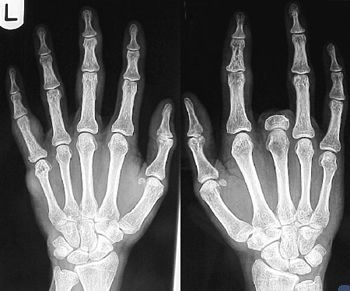
Ultrasound may be a helpful tool for diagnosing and treating rheumatoid arthritis, a new study has found.
A prediction rule for the development of rheumatoid arthritis (RA) in patients with undifferentiated arthritis (UA) has been validated. The rule accurately estimates the risk of RA in more than 75% of patients with recent-onset UA.
Most patients with a confirmed diagnosis of rheumatoid arthritis (RA) use nonbiologic disease-modifying antirheumatic drugs (DMARDs), and the rate of biologic DMARD use is increasing rapidly, according to the American College of Rheumatology (ACR).The organization last updated recommendations for the use of nonbiologic DMARDs in 2002 and had not developed recommendations for using biologic agents.
Tumor necrosis factor α (TNF-α) inhibitor treatment for patients who have rheumatoid arthritis (RA) probably will reduce, not increase, the risk of heart failure if it effectively reduces inflammatory activity.
Yamane T, Hashiramoto A, Tanaka Y, et al, Kobe University GraduateSchool of Medicine, Japan, and other centers. Easy and accuratediagnosis of rheumatoid arthritis using anti-cyclic citrullinatedpeptide 2 antibody, swollen joint count, and C-reactiveprotein/rheumatoid factor. J Rheumatol. 2008;35:414-420.
Occupational exposure to various chemicals, minerals, and toxins may increase the risk of rheumatoid arthritis (RA). Relationships between silica exposure and lung, renal, and autoimmune disease have been observed. Although a relationship between silica exposure and RA has been identified, it is not well defined. The evidence indicating that cigarette smoking is an independent risk factor for RA is conclusive. Agents that may be capable of inducing experimental arthritis in animals include adjuvants from bacteria, yeast, viruses, and mineral oils. In a Swedish study, exposure to any mineral oil was associated with a 30% increased relative risk of RA. (J Musculoskel Med. 2008;25:130-136)
Recent advances in drug therapies for rheumatoid arthritis (RA) have increased the importance of early intervention. Several serological testing and imaging techniques help facilitate early diagnosis. C-reactive protein level and erythrocyte sedimentation rate have limitations in predicting RA. Rheumatoid factor acts as a prognostic marker for later joint damage in patients with early RA. Antibodies against cyclic citrullinated peptide can predict more erosive disease. Radiography currently is the marker for structural damage in RA, but it cannot detect soft tissue changes or actual cartilage deterioration. MRI is the most sensitive imaging modality. Ultrasonography has been shown to be more sensitive than conventional radiography in detecting erosions. (J Musculoskel Med. 2008;25:110-115)
The Disease Activity Score 28 (DAS28) values for patients with rheumatoid arthritis (RA) vary considerably with their perception of pain and their sex.
<em>The outlook for patients with newly diagnosed rheumatoid arthritis (RA) has improved greatly, but many questions remain, including when to initiate therapy and what drugs to use. Recently issued recommendations for managing early RA include referring patients who present with arthritis of more than 1 joint to a rheumatologist. Combination's of drugs have been shown to be more effective than monotherapy. The tumor necrosis factor α inhibitors have revolutionized treatment, and other biologic agents are available for those who have an inadequate response. Making the diagnosis early often presents a challenge. Recently, a prediction rule was published for patients with undifferentiated arthritis of recent onset. The imaging focus for early arthritis has shifted from radiographs to ultrasonography and MRI. (J Musculoskel Med. 2008;25:70-76) </em>
Young-Min S, Cawston T, Marshall N, et al, Queen Alexandra Hospital, Portsmouth, UK, and other centers. Biomarkers predict radiographic progression in early rheumatoid arthritis and perform well compared with traditional markers. Arthritis Rheum. 2007;56:3236-3247.