

Besides the immediate impact of improperly treated pain, children can experience long-Lasting consequences.
Besides the immediate impact of improperly treated pain, children can experience long-Lasting consequences.
Synovial inflammation in osteoarthritis (OA) is secondary to mechanical damage to the articular cartilage and bone. OA often is said to be a disease of weight-bearing joints, but it is more appropriate to consider them as load-bearing joints. OA is the failure of an organ, the synovial joint.
Mary Lynn McPherson gave attendees some poignant reminders about methadone treatment in a lively, entertaining, and informative session.
Physicians who treat athletes with traumatic foot and ankle injuries should know when to order special imaging studies, determine whether injuries can be managed in the office or require referral, and return the athlete to sports activity quickly. For simple ankle sprains, plain x-ray films usually are not indicated; functional rehabilitation is a first-line treatment.
Hepatitis C–related arthropathy is one of the most common extrahepatic manifestations of hepatitis C virus (HCV) infection. Although symptoms can be disabling, the prognosis typically is benign. Patients who have atypical chronic inflammatory arthritis with an unknown cause should be evaluated for HCV infection.
Melanie Thernstrom, Author of
The researchers used animal models with torn ACLs to test 3 types of fluids that could be injected into the joints to serve as a substitute for lost synovial fluid: human synoviocyte lubricin that was created in a culture and then purified to be
There may be genetic susceptibility factors for systemic lupus erythematosus (SLE) that act only in men. In about 1% of families with SLE, all the patients with SLE are male and the women universally have positive antinuclear antibodies; also, men with SLE have more children with SLE than do women with SLE.

Do's and Don'ts of Arthritis
The standard DAS 28 score is the factor most strongly affecting the level of rheumatoid arthritis-related disability, according to a study in the Journal of Clinical Rheumatology.
As reported by the Wall Street Journal, the FDA is seeking advice from a panel of medical experts on whether the antidepressant Cymbalta should be used as a treatment for chronic pain.

On July 2, 2010, CMS released the proposed changes to the Medicare Outpatient Hospital Prospective Payment System for 2011.
Interim final rules clarify the scope of internal claims and appeals procedures and external review processes under PPACA.
Shoulder pain is complex and difficult for even experienced clinicians to diagnose. This article reviews how to use history, simple physical tests, and imaging to distinguish rotator cuff disorders and osteoarthritis from osteonecrosis, adhesive capsulitis, labral tears, or acromioclavicular joint pathology.
anagement of low back pain (LBP) includes a variety of approaches. The clinician should involve patients in the discussion and encourage them to become active participants. Bed rest has many deleterious effects; remaining active is more effective for patients with acute or subacute LBP.
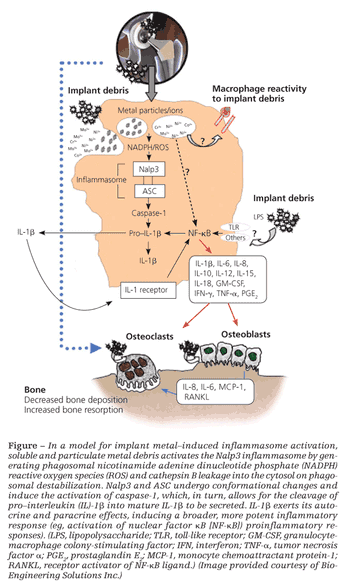
The immune system plays a dynamic role in physiological and pathogenic bone remodeling. Macrophage-, stromal-, and lymphocyte-derived cytokines may induce the activation or inhibition of bone cells and their precursors and cause bone deposition or bone resorption.
More than two-thirds of surveyed patients with gout described the pain of an attack as “miserable,” but one-fourth suggested that persons who do not have gout perceive them as overreacting to attacks and two-thirds think that others do not take the condition seriously.

The timing of the onset of a patient's symptoms can serve as a critical piece of the puzzle when trying to determine a diagnosis.
Inflammatory arthritis includes a variety of diseases; the most common are rheumatoid arthritis, ankylosing spondylitis, and psoriatic arthritis. A large proportion of patients seen in most rheumatology practices have inflammatory arthritis; these patients also are seen in the primary care setting, where they present initially before a diagnosis has been made. The inflammatory arthritides are chronic progressive diseases that can cause irreversible joint damage even early in the disease course.
More than 1 million total joint arthroplasties (TJAs) are performed in the United States each year, and much higher demand is projected. Most TJAs are successful, but aseptic loosening of implants remains a problem that limits long-term success. Aseptic osteolysis, an inflammatory reaction, occurs in up to 10% of patients at 10 years postsurgery.
After a trip to El Salvador, a woman experienced fever, malaise, and other symptoms. She had a history of a positive antinuclear antibodies test result, Raynaud phenomenon, and erythematous rash. The patient was hospitalized for pneumonia, and her symptoms persisted when she received antibiotics. Later her right ankle became red, swollen, and tender. Examination of the patient's extremities showed osteoarthritis changes.
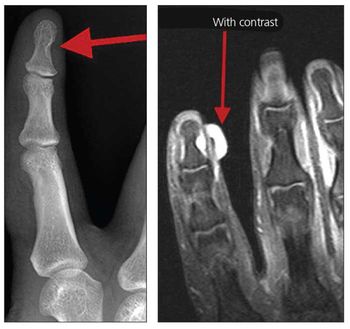
A 25-year-old man was seen in the orthopedic clinic with a complaint of severe, exquisite pain at the ulnar aspect of the distal phalanx of his dominant right index finger. The pain had been present for 10 years, but he had not sought treatment.
The aging process is difficult, involving multisystem functional decline, and the pharmacokinetics of medications are altered in older persons, resulting in increased risks. Concerns are demonstrated in case reports.
ABSTRACT: Achilles tendon injuries are increasing as the population ages yet remains physically active later in life. Early diagnosis and management are important for good long-term outcome, but many injuries are missed or misdiagnosed on initial evaluation.

A new study from the Center for Studying Health System Change analyzes the positive and negative affects that EMR implementation can have on physician-patient interaction.

Some health care IT industry heavyweights have gone so far as to suggest that the iPad will be greatly utilized in the healthcare setting and revolutionize the way we do business. While I do think the iPad is incredibly shiny and is great computer replacement for your grandma, I think it's a bit of an exaggeration to suggest that it will ever be fully adopted by healthcare IT shops.
Modern medicine's technological advances now allow more people to live long enough to develop chronic diseases where the mortality is low but the morbidity high. Hyperchondriacs are acutely aware of this, and perceive great threats in their aging and the future. Hyperchondriacs have similar attributes to hypochondrial patients even as they lack the attendant "symptoms" of a physiologic illness.
Fibromyalgia syndrome (FMS) is not a novel entity-there has been interest in unexplained pain syndromes since antiquity (Figure 1). The earliest research focused on the symptom of “muscle hardenings,” which may be the equivalent of musculoskeletal symptoms that patients with FMS describe today.
Throughout history, various forms of morphine have been the most effective medications in relieving pain. Opioid analgesics-the natural, semisynthetic, and synthetic derivatives of morphine-are used routinely in the management of acute musculoskeletal pain. However, myths and misunderstandings about these drugs often prevent primary care physicians from prescribing them for chronic pain, such as that seen in common musculoskeletal conditions (eg, rheumatoid arthritis, osteoarthritis [OA], osteoporosis, and low back pain [LBP]). Although pain is one of the most common symptoms that bring patients to the physician’s office, those with chronic musculoskeletal or other noncancer pain all too often are undertreated.
There is a high prevalence of 25-hydroxyvitamin D (25[OH]D) deficiency in older men who have radiographic hip osteoarthritis (OA). Because 25(OH)D plays a significant role in bone and cartilage maintenance, therapeutic interventions with vitamin D are warranted to augment their skeletal health.