
In a large real-world PsA cohort, higher BMI reduced the odds of minimal disease activity, especially with TNF inhibitors other than infliximab.
In a large real-world PsA cohort, higher BMI reduced the odds of minimal disease activity, especially with TNF inhibitors other than infliximab.
In RA-BRIDGE and RA-BRANCH, baricitinib failed to demonstrate VTE noninferiority in patients with RA enriched for thromboembolic risk factors.
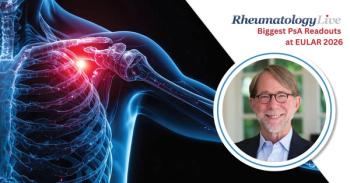
Mease revisits the biggest PsA readouts from EULAR 2026: guselkumab, izokibep, GLP-1 combo therapy and more.
Baricitinib achieved glucocorticoid-free remission in 65% of patients with new-onset polymyalgia rheumatica at week 16, versus 17% with placebo.
Marta Mosca, MD, PhD, highlighted a 43.0% DORIS rate and a 74.1% LLDAS rate during the 12-month follow-up period with anifrolumab.

Hosts Buss and Arnold go over the top highlights from EULAR 2026, including new data from studies in RA, PsA, axSpA, and PMR.

KEEPsAKE 1 long-term data confirm sustained MDA responses, structural protection in nearly 9 in 10 patients, and a cardiovascular safety signal that may favor IL-23 inhibition over JAK inhibitors.
A post-hoc of 5 phase 3 trials saw non-glucocorticoid DORIS remission and LLDAS attainment nearly doubled vs placebo at week 52.

Mease explains the biological rationale behind combining GLP-1 receptor agonist therapy with IL-17 inhibition in patients with PsA and obesity.
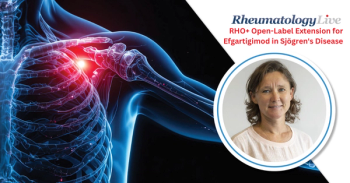
Isabelle Peene, MD, PhD, recaps efgartigimod data showing maintained CRESS response and low disease activity through 48 weeks in the Sjögren's disease RHO+ OLE.
Sarah Dyball, MBBS, PhD, and Kate Harnden, MBChB, join hosts Rihards Buss, MD, to discuss their research at EULAR 2026.

Laurence Duquenne, MD, PhD, joins Joint Ventures to discuss the TEEMS trial and T-cell stratification.

Denis Poddubnyy, MD, PhD, MSc, discusses how non-nociceptive pain is an important piece of treating the whole AxSpA picture.
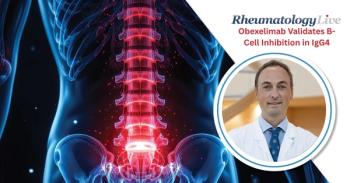
Emanuel Della-Torre, MD, PhD, discusses the largest randomized controlled trial in IgG4-RD establishing proof of concept for B-cell inhibition.
Iain McInnes, MD, PhD, discussed comparing bimekizumab and risankizumab for PsA.
Laura Coates, MBChB, PhD, discusses data showing early separation in ACR50 and disease activity measures at week 4, before substantial weight loss.

Laure Gossec, MD, PhD, discusses new research showing early responders maintain greater patient-reported outcome improvements through year 3.

R. Hal Scofield, MD, discusses exploratory biomarker analyses from DAHLIAS investigating serotype, IFN, and IgG subgroups.

In the FIBRONEER-ILD autoimmune ILD subgroup, nerandomilast attenuated FVC decline and nominally reduced all-cause mortality risk at both doses.

The first phase 3 data for filgotinib in axial spondyloarthritis show early, significant, and durable ASAS40 responses with no new safety signals through 52 weeks.
Philip Mease, MD, discusses BE BOLD, which delivers the first head-to-head superiority result for a joint-focused endpoint in psoriatic arthritis.

Xenofon Baraliakos, MD, PhD, discusses significant improvements in BASDAI and ASDAS scores in new late-breaking data from EULAR 2026.
Richard Furie, MD, discusses phase 2 JASMINE data showing sustained SRI-4 and LLDAS responses through 52 weeks.
Novel CAR-T approaches targeting both CD19 and BCMA signal a paradigm shift in systemic sclerosis, alongside a growing focus on early diagnosis.
Richard Furie, MD, discusses a post hoc analysis of BLISS-LN showing a markedly slower rate of kidney function loss with belimumab versus PBO.
Anisha Dua, MD, MPH, discusses the largest US real-world cohort to date in GPA/MPA.
Anisha Dua, MD, MPH, discusses post hoc data from SELECT-GCA that suggest patients with relapsing disease face substantially higher relapse rates.

Phase 2b/3 data show durable ACR50/70, PASI90/100, and minimal disease activity responses with izokibep through one year.

Check out what coverage RheumLive has slated for the upcoming congress in London.
Hosts Jack Arnold, MBBS, PhD, and Rihards Buss, MD, preview the sessions, themes, and abstracts they are most excited about heading into the meeting in London.