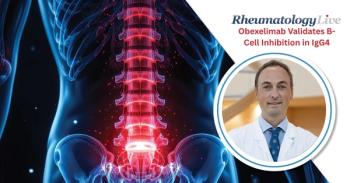
Emanuel Della-Torre, MD, PhD, discusses the largest randomized controlled trial in IgG4-RD establishing proof of concept for B-cell inhibition.
Xenofon Baraliakos, MD, PhD, discusses significant improvements in BASDAI and ASDAS scores in new late-breaking data from EULAR 2026.
Sonelokimab, a Nanobody that inhibits both IL-17A and IL-17F, produced rapid and substantial clinical responses alongside significant reductions in sacroiliac joint (SIJ) inflammation and osteoblastic activity on imaging in patients with active
Xenofon Baraliakos, MD, Medical Director of the Rheumazentrum Ruhrgebiet and Professor of Internal Medicine and Rheumatology at Ruhr University Bochum, Herne, Germany, and current President of EULAR, presented the data and sat down with RheumatologyLive during the congress to discuss its importance.
S-OLARIS (EUCT 2024-513498-36-00) was a single-arm, open-label, proof-of-concept phase 2 study — with no placebo control, a design limitation the authors explicitly acknowledge — enrolling adults with axSpA per 2009 ASAS classification criteria (radiographic and non-radiographic subtypes), a BASDAI score ≥4 despite NSAID treatment, and active disease confirmed on both MRI and ¹⁸F-NaF PET at screening. All 26 enrolled patients received sonelokimab 60 mg at weeks 0, 2, 4, 6, and 8 of a 12-week treatment period.1
At baseline, mean age was 30.7 (standard deviation [SD], 9.5) years, BASDAI was 6.4 (SD, 0.5), ASDAS was 3.5 (SD, 0.4), and BASFI was 4.7 (SD, 2.0); 85% were male, 65% had radiographic axSpA, and 73% were HLA-B27 positive. Only 2 patients (8%) had received prior biologics.1
Clinical responses emerged rapidly. At week 12, 21 of 26 patients (81%) achieved ASAS40 and 14 of 26 (54%) achieved ASAS partial remission. Mean ASDAS improved by −2.0 (standard error [SE], 0.2) from baseline at week 4 (P <.001), with most patients achieving low or inactive disease activity status by week 12; 15 of 26 (58%) achieved an ASDAS major improvement of ≥2 points. Mean BASDAI decreased by 4.7 (SE, 0.3) points (P <.001) and BASFI by 3.3 (SE, 0.4) points (P <.001) from baseline to week 12. Geometric mean hs-CRP declined from 4.0 mg/L at baseline to 2.2 mg/L at week 12. BASMI was low at baseline (mean, 1.2; SD, 0.9) and remained stable at week 12 (1.2; SD, 1.0).1
Imaging outcomes in 25 patients with paired MRI and 24 with paired PET scans showed significant reductions in SIJ inflammation. Mean SPARCC MRI SIJ score fell from 24.8 at baseline to 3.0 at week 12 (P <.001). Background-corrected ¹⁸F-NaF PET SUVmax in the SIJ decreased by a mean of 44% from baseline (mean SUVmax 6.7) to week 12 (mean SUVmax 3.8; P <.001). A 74% reduction in the total number of SIJ quadrants showing both bone marrow edema and ¹⁸F-NaF PET positivity was observed across all patients, from 80 of 192 quadrants at baseline to 21 of 192 at week 12. Spinal ¹⁸F-NaF PET signal was limited at baseline (adjusted SUVmax, 1.1; SE, 0.83), consistent with the low BASMI scores in this relatively early-disease cohort, and remained stable to week 12. SPARCC MRI spine scores also showed a significant reduction from baseline (mean, 4.6; SD, 8.7) to week 12 (mean, 0.7; SD, 2.6; P = .03).1
Sonelokimab was well tolerated through week 16. Fifty-four percent of patients experienced ≥1 treatment-emergent adverse event (TEAE), the most frequent being mild influenza (12%), fatigue (8%), and blood creatine phosphokinase increase (8%). All TEAEs were mild to moderate in severity and mostly considered unrelated to treatment. No adverse events of irritated bowel disease, major adverse cardiovascular events, suicidal ideation/behavior, liver injury, or uveitis were reported.1
"The surprising finding was the clear message that osteoblastic activity is being decreased… we have had some first data on TNF blockers on that topic, but here we see this clearly in a prospective manner," Baraliakos said. "The high numbers need to be confirmed in a placebo-controlled trial, which we are obviously looking forward to conducting."
Baraliakos also noted that bone biopsy analyses from the study are currently underway and expected to report within months, which may provide cellular-level evidence of disease modification with IL-17A/F dual blockade in axSpA.1 A phase 3 trial is under consideration pending these results. All statistical comparisons in S-OLARIS were exploratory; results should be interpreted in the context of the open-label, uncontrolled design.
Baraliakos’ disclosures include AbbVie, Advanz, Alexion, Alphasigma, Amgen, BMS, Celltrion, Cesas, Clarivate, Eli Lilly, Galapagos, Janssen, Johnson & Johnson, MoonLake Immunotherapeutics AG, Novartis, Peervoice, Pfizer, Roche, Sandoz, Springer, Stada, Takeda, UCB, and Zuellig.