






















































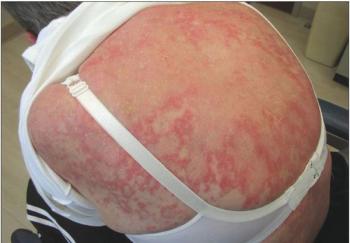
Is it a form of lupus, myositis, or a drug reaction? Check your knowledge of skin eruptions and the associated rheumatologic conditions in this brief photo essay.

Is it a form of lupus, myositis, or a drug reaction? Check your knowledge of skin eruptions and the associated rheumatologic conditions in this brief photo essay.
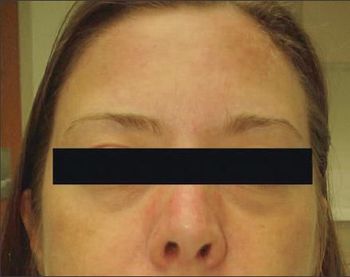
A 39-year-old woman, in her eighth week of pregnancy, experienced aching pain that worsened with activity. Weakness and fatigue set in three days later in her thigh and proximal arm muscle. Then a mildly pruritic rash developed across the forehead, nose, and forearms.

In lupus patients, urinary CD4 T cell counts correlate selectively and specifically with disease activity and renal involvement, well enough to be used to monitor the progress of treatment.
Diagnosing systemic lupus erythematosus (SLE) can take 2-3 years, because most symptoms are both common and nonspecific. Here are clues to quick, accurate detection.

(AUDIO) The primary challenge in lupus diagnosis is nonspecific signs and lack of good biomarkers, says Sam Lim, MD, of the American College of Rheumatology’s Lupus Initiative. Here he sheds light on how to arrive at an appropriate diagnosis.

SLE can manifest as lymphadenopathy. This man fulfilled at least 4 diagnostic criteria for SLE, including rash and blood results.

Rheumatoid arthritis and other autoimmune diseases affect more than 50 million Americans. Coordinated care is the key to reducing direct and indirect costs.
Benlysta (belimumab) has received FDA approval for the treatment of patients with active, autoantibody-positive lupus (systemic lupus erythematosus) who are receiving standard therapy, including corticosteroids, antimalarials, immunosuppressives, and NSAIDs, the agency announced.

Lady Gaga announced that she recently tested borderline positive for lupus. Dr. Pullen talks about lupus tests, false positives, and diagnostic uncertainty.
Diverse mechanisms of pathogenesis have been proposed for the autoimmune diseases. A growing body of medical literature suggests a potential effect of occupational exposures on their development.
There may be genetic susceptibility factors for systemic lupus erythematosus (SLE) that act only in men. In about 1% of families with SLE, all the patients with SLE are male and the women universally have positive antinuclear antibodies; also, men with SLE have more children with SLE than do women with SLE.
ABSTRACT: A 36-year-old woman presented with Raynaud phenomenon, arthralgia, photosensitive rash, proteinuria, dry eyes and dry mouth, and alopecia.
Late-onset systemic lupus erythematosus (SLE), often considered to have a benign disease course, actually involves greater disease activity and comorbidities than early-onset SLE. Differences in disease activity may be associated with an interaction between the SLE and age.
The prevalence and extent of vascular calcification over the thoracic aorta and coronary and carotid arteries are greater in patients with systemic lupus erythematosus (SLE) than in healthy persons. Because the process of atherosclerosis related to SLE disease activity is diffuse and widespread rather than limited to the coronary arteries, coronary calcification used alone as a marker for atherosclerosis may not disclose the association.
The precautionary recommendations for the H1N1 (swine) flu in persons with lupus currently are not different from those for the general public, according to the Lupus Foundation of America (LFA). However, because persons with lupus often are at increased risk for infections, especially if they are taking immunosuppressive agents, they should be particularly vigilant about taking the generally recommended precautions.
Although many medications are used for the management of systemic lupus erythematosus (SLE) and its complications, only aspirin, corticosteroids, and the antimalarial drug hydroxychloroquine (HCQ) are specifically approved by the FDA.1 Most other medications used for SLE treatment are commercially available off label (Table 1), usually borrowed from cancer or transplant regimens. In some cases, medications have been approved for a specific clinical manifestation seen in both idiopathic disease and SLE, such as bosentan for pulmonary hypertension.
Once a diagnosis of systemic lupus erythematosus (SLE) has been made, numerous neurological and psychiatric manifestations may be found to accompany the disease.
The features of systemic lupus erythematosus (SLE) are common in the lifetime course of rheumatoid arthritis (RA) and are significantly associated with an increased mortality risk, even after adjusting for well-described RA-specific predictors of mortality. For some SLE features, the increased risk may be as high as 6-fold.
ABSTRACT: Increased disease recognition and therapeutic advanceshave led to improved survival in patients with systemic lupus erythematosus(SLE) over the past several decades. As a result, managementof the long-term comorbidities and complications of SLE has taken ongreater importance. Maintaining a high index of suspicion for cardiovasculardisease in SLE and screening for traditional risk factors isprudent. Minimizing the use of immunosuppressive agents remainsthe main strategy for decreasing infections, but providing routinevaccinations also can decrease the burden of infections. Despite thehigh prevalence of osteoporosis, screening and treatment remainsuboptimal in patients with SLE and deserve increased attention.Patients with SLE are at increased risk for malignancy and physiciansshould remain vigilant for cancer in these patients. (J MusculoskelMed. 2008;25:316-320)
SLE is an unpredictable and often confusing disease that affects more than 1.5 million Americans and at least 5 million persons worldwide.
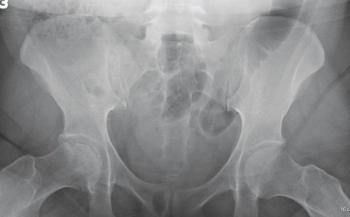
A 29-year-old African American woman came to our rheumatology clinic with right hip pain that had been getting worse for the past 3 months. She had been diagnosed with systemic lupus erythematosus (SLE) 2 years earlier. She reported excruciating right hip pain and mild pain in her left hip on weight bearing and, occasionally, at rest.