News

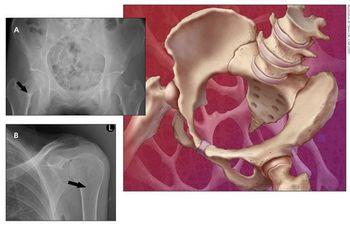
ABSTRACT: Osteopoikilosis is a rare, benign osteosclerotic dysplasiathat predominantly involves the appendicular skeleton. Radiographicfindings are diagnostic, and the disease often is discovered incidentallyon x-ray films. The importance of recognizing osteopoikilosis liesin differentiating it from osteoblastic metastases. The cause is unclear.Patients typically are asymptomatic. Diagnostic findings include theappearance of numerous small,well-defined, spheroid sclerotic foci.Because evidence suggests an association with skeletal and dermatologicalchanges, evaluation for coexisting pathological conditions maybe warranted. The differential diagnosis for a patient who has radiographiccharacteristics similar to those of osteopoikilosis includes osteoblasticmetastases, mastocytosis, tuberous sclerosis, melorheostosis,and osteopathia striata. (J Musculoskel Med. 2008;25:387-389)

ABSTRACT: Corticosteroid/anesthetic injections may be useful diagnosticand therapeutic tools for painful shoulder conditions. The currentdogma is to avoid performing more than 3 injections over a9- to 12-month period, but this rule may be broken. The volume of localanesthetic typically injected might be insufficient for assessing accuracy.Data demonstrating significant advantages of one corticosteroidover another are scarce. For patients with diabetes mellitus, considera somewhat insoluble phosphoric corticosteroid. There is no consensusabout appropriate dosages and techniques.We recommend using1.5-inch 25-gauge needles for most injections. Re-evaluating provocativemaneuvers after each injection is important. The patient's estimatedpain relief always should be documented.Two approaches toinjection may be used, an advanced/detailed method and abasic/quick method. (J Musculoskel Med. 2008;25:375-386)

I was very interested in the article "Chronic pain update: Addressing abuse and misuse of opioid analgesics" by Ross et al (The Journal of Musculoskeletal Medicine, June 2008, page 268) because pain management and addiction medicine is my specialty.The article was interesting, useful, and well written and referenced. However, it perpetuated one myth about opioid prescribing for chronic pain when the authors wrote, "Tolerance develops in most patients who receive long-term opioid therapy."

ABSTRACT: Inflammation of the anserine bursa occurs frequently inathletes who have tight hamstrings, obese patients, patients who haveknee joint pathology, and those who experience direct trauma to thearea. Iliotibial band syndrome results from inflammation of the iliotibialtendon and the bursa. For both injections, the patient may beinjected while lying supine with the leg extended. During anserinebursa injection, the lidocaine and corticosteroid should flow withoutresistance, although some pressure is required. An inability to depressthe syringe plunger requires repositioning of the needle to avoid injectioninto the medial collateral ligament or pes anserinus tendons.(J Musculoskel Med. 2008;25:340-341)

ABSTRACT: Increased disease recognition and therapeutic advanceshave led to improved survival in patients with systemic lupus erythematosus(SLE) over the past several decades. As a result, managementof the long-term comorbidities and complications of SLE has taken ongreater importance. Maintaining a high index of suspicion for cardiovasculardisease in SLE and screening for traditional risk factors isprudent. Minimizing the use of immunosuppressive agents remainsthe main strategy for decreasing infections, but providing routinevaccinations also can decrease the burden of infections. Despite thehigh prevalence of osteoporosis, screening and treatment remainsuboptimal in patients with SLE and deserve increased attention.Patients with SLE are at increased risk for malignancy and physiciansshould remain vigilant for cancer in these patients. (J MusculoskelMed. 2008;25:316-320)

Most patients with a confirmed diagnosis of rheumatoid arthritis (RA) use nonbiologic disease-modifying antirheumatic drugs (DMARDs), and the rate of biologic DMARD use is increasing rapidly, according to the American College of Rheumatology (ACR).The organization last updated recommendations for the use of nonbiologic DMARDs in 2002 and had not developed recommendations for using biologic agents.

There is no clear consensus about which therapiesshould be used for the various underlying pathologies that lead topatellofemoral problems. The major distinction in classification isbetween patellofemoral compression syndrome and patellofemoralinstability. Patients with the former are concerned primarily withpain; those with the latter have instability or pain or both. Patellarpain may manifest in the parapatellar area or radiate to the back ofthe knee. Persons' differing activity and conditioning levels maylead to patellofemoral pain variability. Patients with patellar instabilityinclude those with recurring frank patellar dislocations andthose with symptoms of subluxation. Patients who have patellar instabilitypresent with tears of the medial patellofemoral ligament;this is the "essential lesion" for patellar dislocation. (J MusculoskelMed. 2008;25:297-300)

Each position in football requires a specific set of skillsand predisposes the athlete to types of injury. Physicians need to recognizeand understand the most common patterns, make a diagnosisand provide treatment based on history, physical examination findings,and clinical acumen-all while recognizing and handling emergencysituations. Lower extremity injuries are the most common footballinjuries. The "hip pointer"may be mimicked by avulsion of thesartorius origin or the abdominal muscle attachments. Muscle contusionscan cause myositis ossificans or even lead to compartment syndrome.Noncontact knee injuries include anterior cruciate ligament(ACL) tears. Injuries to the ACL or menisci have been shown to lead toearly osteoarthritis. Inversion/eversion injuries include ankle fracturesand subtalar dislocations. Practical solutions have been developedfor injury prevention. (J Musculoskel Med. 2007;24:290-294)

Opioid analgesics provide effective treatment for noncancerpain, but many physicians have concerns about adverse effects,tolerance, and addiction. Misuse of these drugs is prominentin patients with chronic pain. Recognition and early prevention ofmisuse helps physicians identify the causes and proceed with patientcare. Most persons with chronic pain have a significant medicalcomorbidity (eg, asthma) that affects treatment decisions. All patientsshould undergo an initial comprehensive evaluation. Patientsoften have a psychiatric comorbidity, such as depression or anxiety.There is no gold standard for risk assessment, but several traditionalmeasures may be used. Pain medicine practitioners increasingly areusing urine drug screens to monitor adherence to long-term opioidtherapy. Controlled substance agreements help improve patient compliance.(J Musculoskel Med. 2008;25:268-277, 302)

The latest version of the Clinician's Guide to Prevention and Treatment of Osteoporosis, updated by the National Osteoporosis Foundation (NOF) earlier this year, represents a major breakthrough in the evaluation and treatment of persons who have low bone mass or osteoporosis, according to the organization. The guide provides evidence-based recommendations to help physicians better identify persons at high risk for osteoporosis and fractures and ensure that they are recommended for treatment. It introduces guidelines that address African American, Asian, Latina, and other postmenopausal women-and men aged 50 years and older-as well as white postmenopausal women.

ABSTRACT: Management with corticosteroid injections should beconsidered for a variety of painful shoulder conditions, such ascervical, acromioclavicular, subacromial, glenohumeral, and bicepstendon pathology. Several aspects of the physical examination areused to isolate the anatomical source of a patient's shoulder pain.Knowing how to perform provocative maneuvers and evaluate theresults is critical for making the diagnosis and identifying potentialcorticosteroid/anesthetic injection sites. In our comprehensive16-step shoulder examination, radiographs are not viewed initiallyto avoid bias that can lead to inaccurate diagnosis. When commonprovocative maneuvers for shoulder conditions are used in isolation,their sensitivity and specificity typically are lower than whenthey are used in combination. Obtaining high-quality radiographs isessential. (J Musculoskel Med. 2008;25:236-245)

An estimated 294,000 US children younger than 18 years (or 1 in 250 children) have received a diagnosis of pediatric arthritis or another rheumatologic condition, according to a CDC study designed to gauge the prevalence and annual number of ambulatory health care visits for these disorders. Children with one of the diagnoses account for about 827,000 physician visits each year, including an average of 83,000 emergency department (ED) visits, the study showed. The authors concluded that arthritis-related health care visits impose a substantial burden on the pediatric health care system and that a surveillance paradigm will help monitor and predict young patients' health care needs.

Meier C, Nguyen TV, Handelsman DJ, et al, University Hospital Basel, Switzerland, andother centers. Endogenous sex hormones and incident fracture risk in older men: theDubbo Osteoporosis Epidemiology Study. Arch Intern Med. 2008;168:47-54.

Yamane T, Hashiramoto A, Tanaka Y, et al, Kobe University GraduateSchool of Medicine, Japan, and other centers. Easy and accuratediagnosis of rheumatoid arthritis using anti-cyclic citrullinatedpeptide 2 antibody, swollen joint count, and C-reactiveprotein/rheumatoid factor. J Rheumatol. 2008;35:414-420.

Many hand and finger injuries in ball sports are misdiagnosedor mismanaged, possibly leading to disability. Primary carephysicians who obtain a detailed history, conduct a focused examination,and know the indications for referral can manage themeffectively. The chief complaint is pain. In mallet finger, a finger is"jammed" during sports participation; nonoperative treatment oftenis indicated. The ring finger is involved in most reported cases of jerseyfinger; surgical intervention is the treatment of choice. Managementof boutonnière deformity helps patients regain full strengthand range of motion. Collateral ligament injuries may occur at anyinterphalangeal joint. Finger fractures are the fractures most oftenseen in the primary care setting. Malrotation with phalangeal fracturesis unacceptable. (J Musculoskel Med. 2008;25:198-204)

The wrist, a complex joint, often is involved in inflammatoryarthritis, such as rheumatoid arthritis or psoriatic arthritis. Wristsynovitis causes pain, swelling, and loss of extension. Extension of thesynovial lining may lead to synovitis of the ulnar styloid. During injectionof the ulnocarpal joint, the lidocaine and corticosteroid mixtureshould flow without resistance. Injecting air after corticosteroidinjection of the ulnar styloid creates a seal that prevents the corticosteroidfrom leaking up the needle tract into the dermal layer and creatingunsightly depigmentation. (J Musculoskel Med. 2008;25:188-189)

Demand for total joint replacement (TJR) surgeries will far outstrip supply in the coming years, significantly diminishing the quality of patient care, and methicillin-resistant Staphylococcus aureus (MRSA) infection threatens to become a "21st-century plague,"according to speakers at the recent American Academy of Orthopaedic Surgeons (AAOS) annual meeting held in San Francisco.The breakthrough potential of stem cells, tissue engineering, and gene therapy in musculoskeletal medicine was another key area of discussion.

Ioachimescu AG, Brennan DM, Hoar BM, et al, Cleveland Clinic, Ohio. Serum uric acid is an independent predictor of all-cause mortality in patients at high risk of cardiovascular disease: a preventive cardiology information system (PreCIS) database cohot study. Arthritis Rheum. 2008;58:623-630.

Shin pain is a common complaint in runners and otheractive patients. Making a diagnosis can be difficult because the differentialis broad and symptoms may overlap. Palpation is an importantpart of the physical examination. The primary presentingsymptom in medial tibial stress syndrome, or "shin splints," is painlocalized to the medial border of the distal third of the tibia. Relativerest eliminates the inciting activity. The most obvious examinationfinding in tibial stress fractures is localized bony tenderness; triplephasebone scanning is the gold standard in making a diagnosis.High-risk fractures require aggressive management. The mainstay ofdiagnosis of chronic exertional compartment syndrome is measurementof resting and postexercise compartment pressures. Treatmentmay be conservative or surgical. (J Musculoskel Med. 2008;25:138-148)

Occupational exposure to various chemicals, minerals, and toxins may increase the risk of rheumatoid arthritis (RA). Relationships between silica exposure and lung, renal, and autoimmune disease have been observed. Although a relationship between silica exposure and RA has been identified, it is not well defined. The evidence indicating that cigarette smoking is an independent risk factor for RA is conclusive. Agents that may be capable of inducing experimental arthritis in animals include adjuvants from bacteria, yeast, viruses, and mineral oils. In a Swedish study, exposure to any mineral oil was associated with a 30% increased relative risk of RA. (J Musculoskel Med. 2008;25:130-136)

Our case report demonstrates the importance of conducting a thorough neurological examination in the evaluation of lateral ankle sprain. The patient, a dancer, reported an inversion injury to his ankle that was associated with lateral ankle pain, numbness, and paresthesia. The patient had positive Tinel test results over the distal portion of the leg in the distribution of the sural nerve. The diagnosis was a grade 1 lateral right ankle sprain complicated by an injury to the sural nerve. Treatment included scheduled anti-inflammatory medication and limited icing of the ankle. The patient returned 1 week later and reported significant improvement; after 1 month, he had returned to full activity. Knowledge of sural nerve anatomy is essential for examining physicians to make this diagnosis. (J Musculoskel Med. 2008;25:126-128)

Recent advances in drug therapies for rheumatoid arthritis (RA) have increased the importance of early intervention. Several serological testing and imaging techniques help facilitate early diagnosis. C-reactive protein level and erythrocyte sedimentation rate have limitations in predicting RA. Rheumatoid factor acts as a prognostic marker for later joint damage in patients with early RA. Antibodies against cyclic citrullinated peptide can predict more erosive disease. Radiography currently is the marker for structural damage in RA, but it cannot detect soft tissue changes or actual cartilage deterioration. MRI is the most sensitive imaging modality. Ultrasonography has been shown to be more sensitive than conventional radiography in detecting erosions. (J Musculoskel Med. 2008;25:110-115)

Injectable corticosteroids may be used for managing painful shoulder conditions, but there are no universally accepted guidelines for dosage and administration. Understanding the mechanisms of action is critical for knowing when they can be used effectively. The biggest absolute contraindication to intra-articular or extra-articular corticosteroid injections is evidence or probability of infection. Relative contraindications include anticoagulation therapy, hemarthrosis, and poorly controlled diabetes mellitus. Most complications result from frequent use and can be avoided with appropriate doses and dosing intervals. Intra-articular and periarticular corticosteroid injections may cause significant systemic effects. The misuse of corticosteroid injections often is overuse. Creation of uniform guidelines for injections would help reduce their deleterious effects and maximize pain relief. (J Musculoskel Med. 2008;25:78-98)