

ACR2013: Highly specific and sensitive for Sjögren's syndrome, ultrasound of the salivary gland can also benefit the accuracy of the new ACR criteria for the disorder.
ACR2013: Highly specific and sensitive for Sjögren's syndrome, ultrasound of the salivary gland can also benefit the accuracy of the new ACR criteria for the disorder.
Reports in a pediatric ophthalmology journal reveal risk factors and best treatments for refractory/recurrent uveitis in JIA.
ACR2013: Apremilast, a new kind of anti-inflammatory, proved significantly better than placebo against psoriatic arthritis after 52 weeks. Adverse effects were short-lived. Results for ustekinumab also held up after a year.
Noting that it takes an average of 5 years before a fibromyalgia patient receives a diagnosis, researchers conducted a retrospective data analysis to identify significant variables that may enable earlier detection and diagnosis of fibromyalgia.
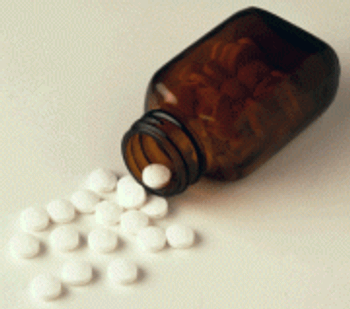
While the use of acute, high-dose systemic corticosteroids probably has no clinically significant effect on wound healing, chronic systemic corticosteroids may impair postoperative healing in susceptible patients.
Small case study reveals psoriatic arthritis risk with ustekinumab use for psoriasis. Also: Regulators toughen up on painkiller labeling, but is it enough?

Acronym alert: European rheumatologists are proposing new subtypes of disease-modifying antirheumatic drugs, prompted by advances in methods of drug development.
ACR2013: More familiar as a suspect in Alzheimer disease, amyloid proteins may trigger autoantibodies in lupus when introduced via infection, a mouse study suggests.
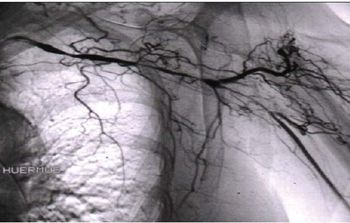
An intense search is underway for better ways to support treatment decisions in the vasculitides. Here are the most promising candidate biomarkers for identifying active disease and predicting relapse.
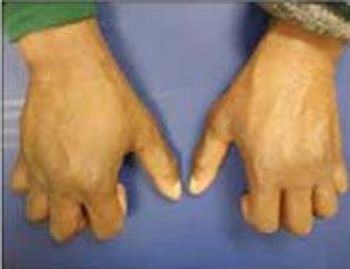
Bilateral puffy hands are a tip-off of a diagnosis that is growing in prevalence and in importance to rheumatology. What should they call to mind?
New joint criteria for systemic sclerosis are more sensitive than older versions and will allow faster and more accurate diagnosis.

Recent English-language guidelines agree that rheumatoid arthritis (RA) needs to prompt treatment. But the definition of "early RA," and the regimens, differ considerably.
Examining the right foot of a 54-year-old male reveals a red, swollen, warm, and exquisitely tender right first toe joint. What is the differential diagnosis?
The FDA has approved ustekinumab (Stelara) alone or as an adjunct to methotrexate for adults with psoriatic arthritis.
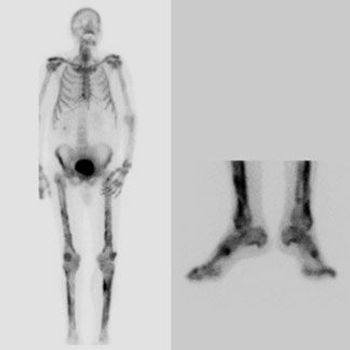
The patient presented with fever, dyspnea, and productive cough. He also had worsening lower-extremity arthralgia. Can you guess the diagnosis?
In a 30-year-old woman with decreased range of motion in several joints, radiographs show bony fusion, profound osteopenia, erosions and advanced arthrosis.
A tocilizumab-methotrexate combo appears to inhibit circulating biomarkers of joint tissue remodeling at sites of inflammation in rheumatoid arthritis.
For the first time, the European Medicines Agency's biosimilars program has recommended approval of a monoclonal antibody. It has given thumbs-up to an alternative formulation of infliximab to treat inflammatory conditions including RA, ankylosing spondylitis, and psoriatic arthritis.

With the FDA poised to issue guidance for mobile health app designers, this review includes several well-regarded apps for rheumatoid arthritis and mentions a few newcomers.
Rheumatoid arthritis patients taking a combination of etanercept (Enbrel) and methotrexate do better, but only slightly, than those on monotherapy with the tumor necrosis factor-α inhibitor, according to a Canadian multicenter clinical trial.
Michael R. Clark, MD, MPH, MBA, outlines the vulnerabilities that put patients with acute pain at risk of transitioning into new chronic pain.
Final results from the international AMPLE Trial show nearly identical benefits for abatacept (Orencia) and adalimumab (Humira) plus methotrexate for early rheumatoid arthritis.
Last week the major British journal published an exhaustive series of reviews on autoimmune rheumatic disease, summarized briefly here. Also new in the nonspecialty journals: Macitentan for pulmonary hypertension, small fiber neuropathy in Sjögren syndrome, and risk factors for infection with glucocorticoids.

Using nutritional supplement mixtures consisting of arginine, glutamine, and beta-hydroxy-beta-methylbutyrate (HMB) may speed up wound healing in diabetic foot ulcers.
This young woman presented with severe leg pain, night sweats, and fever of unknown origin. The diagnosis of polyarteritis nodosa had several unusual features.
For early undifferentiated arthritis, give methotrexate or combinations of DMARDs and corticosteroids sooner rather than later to suppress disease activity and radiographic progression, says a literature review.
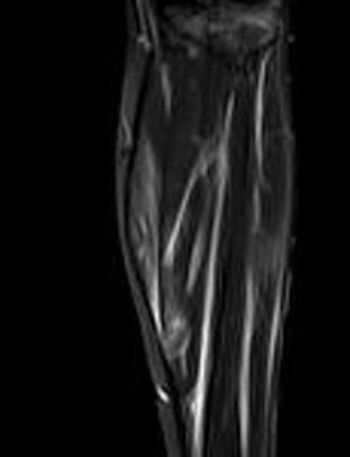
She presented with such severe calf pain she could no longer walk unassisted, with a months-long history of fever of unknown origin. What does the MRI show?
Most fibromyalgia patients randomized to continuing milnacipran (Savella) at the end of a clinical trial never noticed an increase in pain. Patients in the placebo group had quite a different experience.
A biomarker of tissue destruction called C1M can show disease activity among rheumatoid arthritis patients to monitor drug therapy, and can detect joint damage progression.
Contrary to American College of Rheumatology recommendations, analysis of data from a clinical trial reveals methotrexate monotherapy as the best initial treatment for early rheumatoid arthritis that has a poor outlook.