Ruderman discusses how Northwestern's joint dermatology-rheumatology clinic shapes diagnosis and treatment of psoriatic disease.
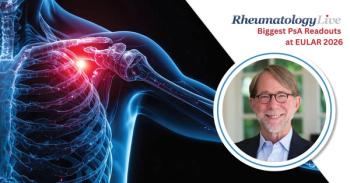
With structural inhibition now in the label, Mease explains why radiographic protection matters as a treatment goal and what it means to have that evidence for an IL-23 inhibitor.
When rheumatologists evaluate treatment options for psoriatic arthritis (PsA), they weigh several pillars: symptom and sign improvement, safety, and the ability to halt or inhibit structural joint damage. The first 2 have long been available for guselkumab (Johnson & Johnson’s Tremfya). The third arrived on May 28, 2026, when the FDA approved a supplemental label update adding evidence of structural joint damage inhibition — making guselkumab the first and only IL-23 inhibitor with that claim in its US prescribing information.1
Philip Mease, MD, Director of Rheumatology Research at Providence Swedish Medical Center and Clinical Professor of Medicine at the University of Washington School of Medicine, Seattle, spoke with RheumatologyLive about what the update means clinically. Mease served as an APEX trial investigator.
Structural joint damage in PsA manifests radiographically as erosions — breakdown of the bony architecture at the joint margin — and joint space narrowing, both of which can be tracked over time on plain x-rays or other imaging. As joint disease progresses, this damage becomes irreversible and functionally limiting. "As you look at x-rays over time, the joints gradually crumble and are no longer functional, and quite painful," Mease said. While virtually all approved biologic DMARDs and targeted synthetic DMARDs have demonstrated structural inhibition, that evidence had not previously existed for any IL-23 inhibitor.
The label update is supported by the phase 3b APEX trial, which enrolled biologic-naive adults with active PsA who had inadequate responses to standard therapies and required at least 2 erosive joints at baseline — enriching the population for patients with established structural disease.2 Patients were randomized to guselkumab 100 mg every 4 weeks (Q4W), guselkumab 100 mg at weeks 0 and 4 then every 8 weeks (Q8W, the approved label dose), or placebo. At week 24, the least-squares mean change from baseline in total PsA-modified van der Heijde-Sharp score — a composite measure of erosion and joint space narrowing — was 0.55 for Q4W and 0.54 for Q8W, versus 1.35 for placebo (P = .002 and P <.001, respectively), representing approximately 2.5-fold greater inhibition of radiographic progression.2 Mease noted that response rates were essentially equivalent between the monthly and every-2-months dosing schedules, which solidified the approved Q8W dose's structural protection credentials.
"Now we can tell a patient not only that symptoms and signs of pain and stiffness and fatigue will improve, your function will improve — now we can also say that it inhibits structural damage," Mease said. "This sets it apart. We don't have that evidence yet for other IL-23 inhibitors, and so I think it's a welcome addition to the label."
Structural inhibition data require a deliberately designed trial — specifically, radiographic endpoints included as primary or ranked secondary outcomes in a study powered to detect them. Risankizumab's pivotal PsA trials were not designed to assess radiographic progression as a primary or ranked secondary endpoint, meaning the absence of structural data for other IL-23 inhibitors reflects a trial design reality rather than a demonstrated lack of effect.1 Nonetheless, the label claim stands as a differentiator in conversations with patients at risk for progressive joint damage.
Mease’s disclosures include AbbVie, Acelyrin, Amgen, BMS, Century, Cullinan, Eli Lilly and Company, Inmagene, Johnson & Johnson, MoonLake Immunotherapeutics, Novartis, Pfizer, Inc., Sana, Spyre, Takeda, and UCB.