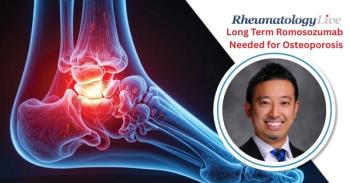
Koji Ishikawa, MD, PhD, emphasized that 12 months of romosozumab showed benefits for osteoporosis.

Interstitial lung disease (ILD) is a major driver of morbidity and mortality across systemic autoimmune rheumatic diseases (SARDs), including systemic sclerosis, myositis, rheumatoid arthritis (RA), and
In September 2026, Jessica Gordon, MD, MS, a rheumatologist and chief of the scleroderma clinic at Hospital for Special Surgery (HSS) in New York, moderated a clinical forum for rheumatologists on SARD-associated ILD. Participants included rheumatologists from HSS, NYU Langone, Mount Sinai, Montefiore, Northwell Health, and private practices in New York and New Jersey. In a follow-up video interview with RheumatologyLive, Gordon revisited the forum's main themes.
Gordon told participants that clinically significant ILD occurs in about 65% of patients with systemic sclerosis, more than 40% with myositis or mixed connective tissue disease, about 10% with RA, about 25% with Sjögren disease, and about 5% with lupus. In the interview, she said rheumatologists already prioritize screening in systemic sclerosis and antisynthetase syndrome but may not think of ILD as often in RA and Sjögren disease, and she noted that the Sjögren figure was eye-opening for many forum participants.
For patients outside those highest-risk groups, Gordon said guideline-listed risk factors help guide screening, such as male sex, seropositivity, and smoking in RA, and Ro52 positivity, Raynaud phenomenon, and lymphopenia in Sjögren disease.¹ Several participants said they screen patients with RA selectively based on those risk factors or on symptoms and examination findings, and 1 participant described ordering chest radiographs for patients with RA, though Gordon noted the guideline favors PFT and HRCT over chest radiography.
After a negative baseline screen, Gordon said she primarily follows PFTs and repeats HRCT when PFTs decline or symptoms change, which limits radiation exposure and cost. In the interview, she described PFT monitoring as a way to continue surveillance without the risks of repeated computed tomography. She also reviewed the PPF definition, which requires 2 of 3 criteria: worsening respiratory symptoms, physiologic decline of at least 5% predicted in forced vital capacity or at least 10% predicted in hemoglobin-corrected diffusing capacity, and radiologic progression.
Participants said many patients reach them through incidental findings on coronary or other CT scans followed by serologic testing from pulmonology. Several described joint rheumatology-pulmonology clinics or multidisciplinary conferences with radiology as especially valuable when imaging is ambiguous.
Gordon reviewed the FDA-approved options, including nerandomilast for idiopathic pulmonary fibrosis and PPF, nintedanib for idiopathic pulmonary fibrosis, PPF, and systemic sclerosis-associated ILD, and tocilizumab for systemic sclerosis-associated ILD, alongside guideline-recommended immunomodulators such as mycophenolate, rituximab, and azathioprine.²,³ Participants said rheumatologists typically start immunosuppression when the autoimmune disease appears to drive ILD and involve pulmonology when a usual interstitial pneumonia pattern or smoking history raises questions about fibrosis. Several said payer requirements to try other antifibrotics first have slowed uptake of newer agents.
In the interview, Gordon said she now co-manages patients with ILD with pulmonology rather than managing them alone, typically starting an immunomodulator and adding an antifibrotic when imaging shows progression or a significant fibrotic component. She said access to PFTs and ILD-focused pulmonologists varies widely between academic and community settings, and that community rheumatologists may need a pulmonary referral simply to obtain testing.
"So I think thinking about this and thinking about different ways that we can operationalize relationships between rheumatologists and interested pulmonologists is really helpful," Gordon said.
Gordon also pointed to ongoing trials of nerandomilast in SARD-ILD and systemic sclerosis, belimumab and other B-cell-directed approaches, inhaled prostacyclin therapy, and CAR T-cell therapy in multisystem autoimmune disease.